We are located in central Singapore with close access to two MRT lines and various bus stops.
1 Aljunied Walk, Singapore 387293
IB Extended Essay Guide: What It Is, How It’s Graded, and Why It Matters
While the IB Extended Essay (EE) is often seen as one of the most challenging parts of the International Baccalaureate Diploma Programme (IBDP), it’s also one of the most rewarding. It may seem like just a long research paper, but it helps learners develop essential academic and personal skills that prepare them for university essay writing and life beyond the classroom.
In this guide, we unpack the Extended Essay, exploring its process, how it supports learner growth, how it’s assessed, and the way Nexus guides learners through this process. We also speak to Ms Rose Vu, Extended Essay Coordinator at Nexus International School (Singapore) who shares her valuable insights and experiences.
We will discuss:
What is the IB Extended Essay?
Purpose of the IB Extended Essay
How Many Points Is the Extended Essay Worth
How is the Extended Essay assessed?
Why is the Extended Essay a valuable experience?
What is the process of the Extended Essay – including the timeline and support offered
How do IB students choose their topics?
How to prepare for the Extended Essay
What is the IB Extended Essay?
The Extended Essay (EE) is an independent, self-directed piece of research that culminates in a 4000-word paper. It is one of the three core components of the IBDP and it is compulsory for all learners, regardless of which subjects they have chosen.
The EE aims to provide learners with an opportunity to dive deep into a topic that they’re genuinely interested in, often allowing them to explore knowledge beyond the classroom syllabus.
Purpose of the IB Extended Essay
Beyond research and academic purposes, the Extended Essay exposes learners to the important process of self-management, time-management and organisational skills.
There is also a reflection, separate from the 4000-word essay, which is roughly 500 words in length. Under the new IB guide starting in 2026 (with first assessment in 2027), the EE will be marked out of 30, with 4 marks allocated to the reflection.
How Many Points Is the Extended Essay Worth in the IB Diploma?
In the IBDP, 3 points are awarded based on the combined results of the Extended Essay (EE) and Theory of Knowledge (TOK). The remaining 42 points come from six subjects, each graded out of 7.
Using a matrix, the IB determines how many of the three points will be awarded to the overall diploma score based on the learner’s performance on the EE and TOK.
Candidates can earn between zero to three points towards the overall diploma points. The number of points is calculated using the table below.
It is important to understand that receiving a grade of “E” in either the EE or TOK is considered a failing condition for the Diploma. Even if a learner achieves subject scores, they would not be awarded the Diploma as they have not successfully completed all the IB core components. In short, this means that it is possible to fail the Extended Essay, which would lead to overall failure of the Diploma.
How Is the IB Extended Essay Assessed?
The IB Extended Essay (EE) is graded according to a set of general criteria, though there are subtle differences depending on whether a learner chooses a subject-specific or interdisciplinary topic.
All Extended Essays are assessed on core elements such as:
Knowledge and understanding of the topic
Critical thinking
Presentation and structure
Engagement with the research process
In a subject-specific EE, markers will look for mastery of discipline-specific terminology and academic conventions. This would include things like using appropriate technical language in a science or economics essay.
In contrast, an interdisciplinary EE (such as one done in I&S subjects) is judged on how effectively the learner communicates complex ideas to a broader audience. Here, the focus is on synthesis and clarity across multiple disciplines rather than technical depth in just one.
To put it simply: subject-specific essays are written like specialists communicating with experts, while interdisciplinary essays are crafted to inform an educated general audience.
What is the process of the Extended Essay?
The EE is a significant undertaking for high-school aged learners. After all, writing a 4000-word essay is a big challenge, even at the university level! As it is such a substantial task, schools will provide structures and guidance to help learners throughout the process.
Timeline of the Extended Essay
“The start and timeline of the IB Extended Essay (EE) are set by each school, as the IB does not prescribe fixed dates,” shares Ms Vu. The IB’s website also recommends that individuals reach out to specific schools to learn more about the deadlines.
“At Nexus, the EE process lasts for one-year, typically beginning in Term 2 of Year 12 (First year of the DP), where learners are introduced to the EE, research skills, and components of the guide. Even though there are two years in the DP, we try to ensure that it does not go on for too long and we also make sure that the deadline is far ahead of the official deadline to account for any necessary buffer time.”
Nexus learners will usually propose a research question by January or February and submit a partial draft of about 2000 words in April. At this time, learners would have completed their research and have an introduction, methodology and part of the analysis written. By the time learners start term 1 of Year 13, they would have already submitted their first full drafts and gotten feedback from their supervisor. This timeline allows them to complete everything by the end of term 1.
“While this may seem like a rush or that it is completed very early, it is actually carefully planned to account for the competing interests of the IB Diploma,” comments Ms Vu.
While the EE is a large project, learners have many other components that they have to engage in, including internal assessments, trial exams, Creativity, Activity, Service (CAS) amongst many others. Another factor to consider would be the learner’s motivation – if the process goes on for too long, learners can end up procrastinating or find it difficult to maintain focus. Ms Vu also shared that when she attended workshops with other EE coordinators that work in Singapore and the APAC region, many schools also employ a similar one-year approach as it has been proven to work well.
Support for the Extended Essay
Each learner is assigned a dedicated supervisor who guides them throughout the EE process. For subject-specific essays, learners work with teachers who specialise in that subject. For interdisciplinary essays which combine two subjects, learners may not work with any subject-specific supervisor as the focus is on the learner’s ability to integrate and apply knowledge across different disciplines.
With the support from supervisors, teachers and coordinators, Nexus learners never face the IBDP journey alone. Beyond baselines scheduled sessions, learners are encouraged to seek help whenever they need it. The teachers also ensure that they are easily accessible, fostering an environment where learners feel comfortable reaching out.
This approach is intentional as Nexus aims to empower learners to take the initiative, building good communication and social skills that will benefit them in university and beyond. Through regular check-ins and close follow-ups, the IBDP team ensures that every learner receives personalised support and no one is left behind.
This close-knit community of educators and learners reflects Nexus’ dedication to nurturing growth, resilience, and success through the Diploma Programme.
How Do IB Students Choose Their Extended Essay Topics?
While the IB Extended Essay does allow learners a great deal of freedom when selecting a topic, it is crucial to choose wisely – after all, this is a graded academic research paper. Ms Vu explains that at Nexus, while learners are highly encouraged to choose topics that spark their interest, they are also guided towards choices that offer a strong foundation for success.
For instance, a learner who wants to study medicine may choose a pure Science EE or an interdisciplinary EE with a Science and Individuals and Societies focus to broaden their scope. Our IBDP team typically encourages learners to go with interdisciplinary essays as they tend to score better. It also shows their ability to analyse real world data across disciplines.
Ultimately, learners are supported to balance passion and practicality when choosing topics, ensuring that they are both meaningful and suitable for scoring well.
Inquiry-based learning is a cornerstone of the IB programme, beginning in the Early Years and continuing all the way to the Diploma Programme. While inquiry remains a recurring aspect, the way learners engage with it shifts as they develop academically and cognitively.
In the Primary Years Programme (PYP), inquiry is rooted in open-ended exploration. Learners are encouraged to ask questions, investigate real-world issues and collaborate with others. All of this helps build great soft skills such as independence, curiosity and social-emotional awareness. At this stage, there is a strong focus in nurturing a love of learning and building confidence in expressing ideas.
As learners move into the IBDP, inquiry becomes more strategic and purposeful. While learner agency still takes a centre stage (especially at Nexus), educators introduce an element of “scaffolded inquiry”, where learners still use inquiry-based learning but aligns it with the demands of an academic assessment. Ms Vu elaborates further by explaining that this teaches learners to take calculated risks based on critical thinking and evaluative skills.
This evolution mirrors what learners will experience in higher education: fewer guardrails, more independence and a greater emphasis on how to approach complex problems without being handed the answers. With this progression, learners develop an inquisitive mindset while still being able to navigate ambiguity with confidence. This valuable skill will take them a long way, even after the IB.
What Makes the IB Extended Essay Valuable?
The IB Extended Essay (EE) offers learners the platform to develop essential university and life skills. Through the EE, learners gain:
The ability to discern credible information in a world of AI and fabricated media
Research and academic writing skills that mirror the expectations of university-level coursework
Critical thinking skills, open-mindedness and a holistic mindset that allows them to view the world from multiple perspectives
Ability to work independently and time management skills
The EE also adds real value to university applications, demonstrating depth to tertiary institutions that they apply to. If learners completed an EE subject/topic that aligns with their university major choice, it boosts their application, showing a commitment to the field. For those who take the interdisciplinary route, it demonstrates a strong ability to consider multiple perspectives and think across subject boundaries. In both cases, the EE showcases a learner’s ability to conduct independent research and complete a university level paper, an indication of strong academic performance.
Time management is one of the biggest and most common challenges of the Extended Essay. For many, the EE is often the first time that they are required to plan and manage such a lengthy and self-directed project. This challenge affects even the most organised learners, not just those who may struggle with their organisational skills. As there are other components within the IBDP like subjects areas, TOK and Creativity, Activity, Service (CAS), learners will have to learn to manage competing priorities and use their time effectively.
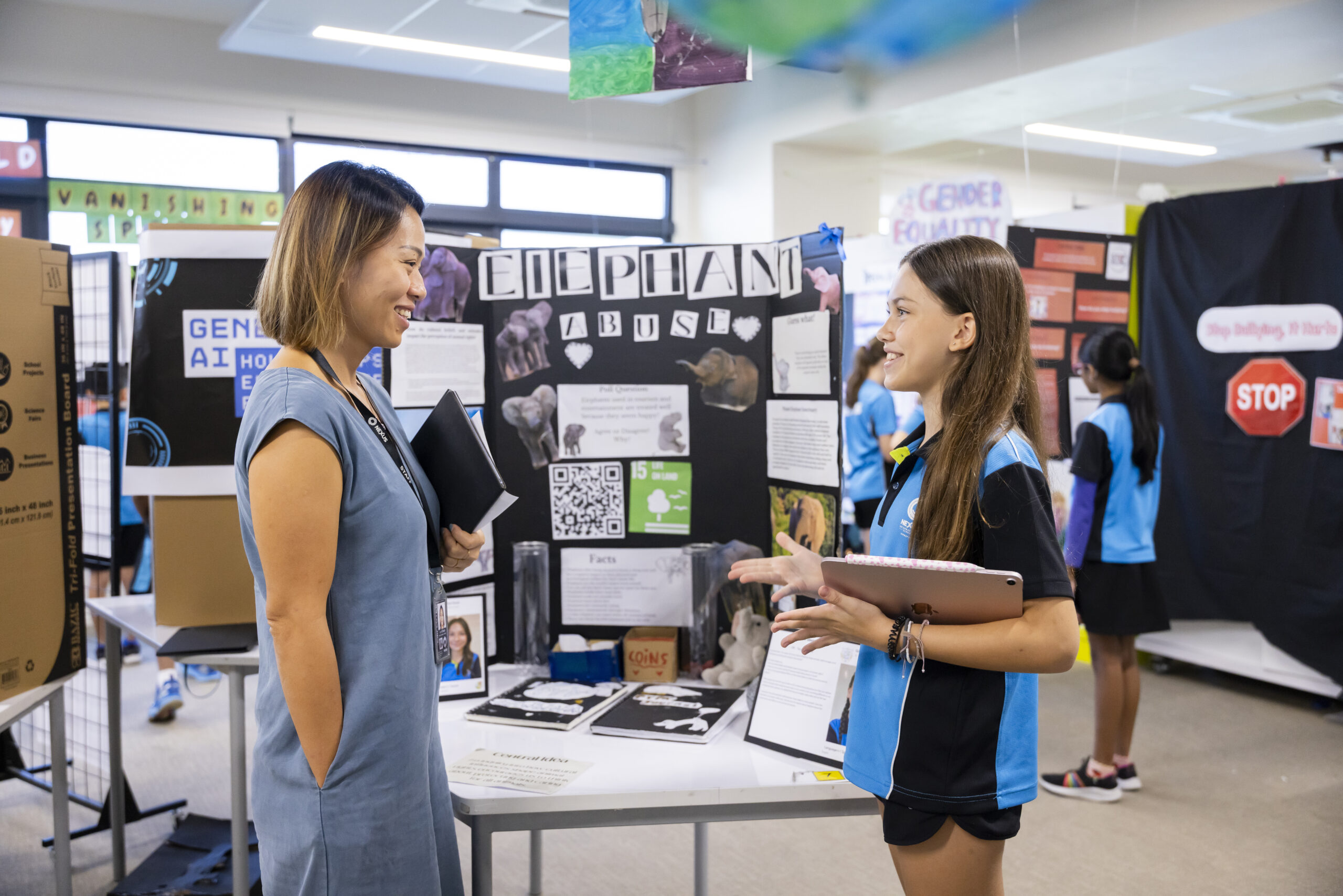
Another significant challenge lies in the development of strong research skills. Learners will be challenged to move beyond simply gathering information online and knowing how to identify credible, relevant sources and evaluating their reliability. At Nexus, our learners work closely with our teacher librarian who guides them through research strategies. They are also given the opportunity to apply these skills in practice.
With the recent and rapid rise of artificial intelligence tools like ChatGPT and other generative platforms, a new challenge has emerged for IB learners: understanding how you should use AI ethically and appropriately during the Extended Essay process.
The IB takes a forward-looking approach and “does not believe that AI tools should be banned in education.” Instead, the organisation recognises that as these technologies become more powerful and widespread, banning or ignoring them hinder the learners’ ability to adapt when it truly becomes mainstream. As such, the IB believes that education should “equip [learners] to deal with [AI] competently and ethically.”
For example, AI may be used to brainstorm or identify potential resources in the initial phase, but learners will be expected to review the information with a critical eye. Ethicality and integrity are also important parts of this conversation as learners navigate the use of AI. They need to learn how to use AI as tools that can support research, rather than using it as a shortcut to generate or write content.
At Nexus, learners engage in meaningful conversations with our educators and our teacher librarian to understand how they should engage with AI through the Extended Essay. These crucial conversations allow learners to navigate AI in a balanced and principled way. This ensures that they not only adhere to the IB academic integrity policies, but are also prepared with this future-ready skill that will be needed in university and beyond.
How to Prepare for the IB Extended Essay
“In my experience doing workshops with parents, I always encourage them to find out what their children are interested in.”, Ms Vu shares.
She reveals that Nexus learners have also echoed the same, encouraging others to work on a topic that they were interested and passionate about. Both Ms Vu and the learners confirmed that it was key to overcoming any challenging times that may impact your motivation.
For parents, Ms Vu encourages early conversations around interests, curiosity and current affairs at home. She shares that parents can ask open-ended questions like:
“What are you interested in?”
“Which subjects do you enjoy and excel in?”
“Have you heard about [current affair]?”
These conversations at home can kickstart the ideation process, allowing learners to identify potential EE topics that they would like to explore.
The IB Extended Essay In Summary
Beyond an academic requirement, the IB Extended Essay is a transformative experience that builds key skills for university and future success. At IB international schools like Nexus International School (Singapore), learners are guided with intention: from choosing meaningful topics to developing strong inquiry and research skills. With dedicated support and a structured process, learners are supported throughout the process of writing their Extended Essay, building key competencies like independence, time management, and research skills amongst many others. Whether subject-specific or interdisciplinary, the EE remains one of the most valuable components of the IB Diploma.