We are located in central Singapore with close access to two MRT lines and various bus stops.
1 Aljunied Walk, Singapore 387293
More Than Just a Number: How Maths Teaching at Nexus Helps Every Learner Thrive
At Nexus, we are incredibly proud of our approach to teaching Mathematics. Strong academic results sit alongside engaging, high-quality classroom practice, as part of a mathematical journey that begins in the Primary School and builds confidence at every stage. Below, we share recent achievements from our Secondary Maths department and explain how they are using assessment data to support progress for every learner.
Excellence in Every Result
In Mathematics, our Secondary school learners consistently make progress above their predicted grades from Year 7 up to IGCSE and IB level. Learners achieve highly across IGCSE and IB, with consistently strong outcomes regardless of which Maths teacher they are taught by — a reflection of the department’s shared approach and high expectations.
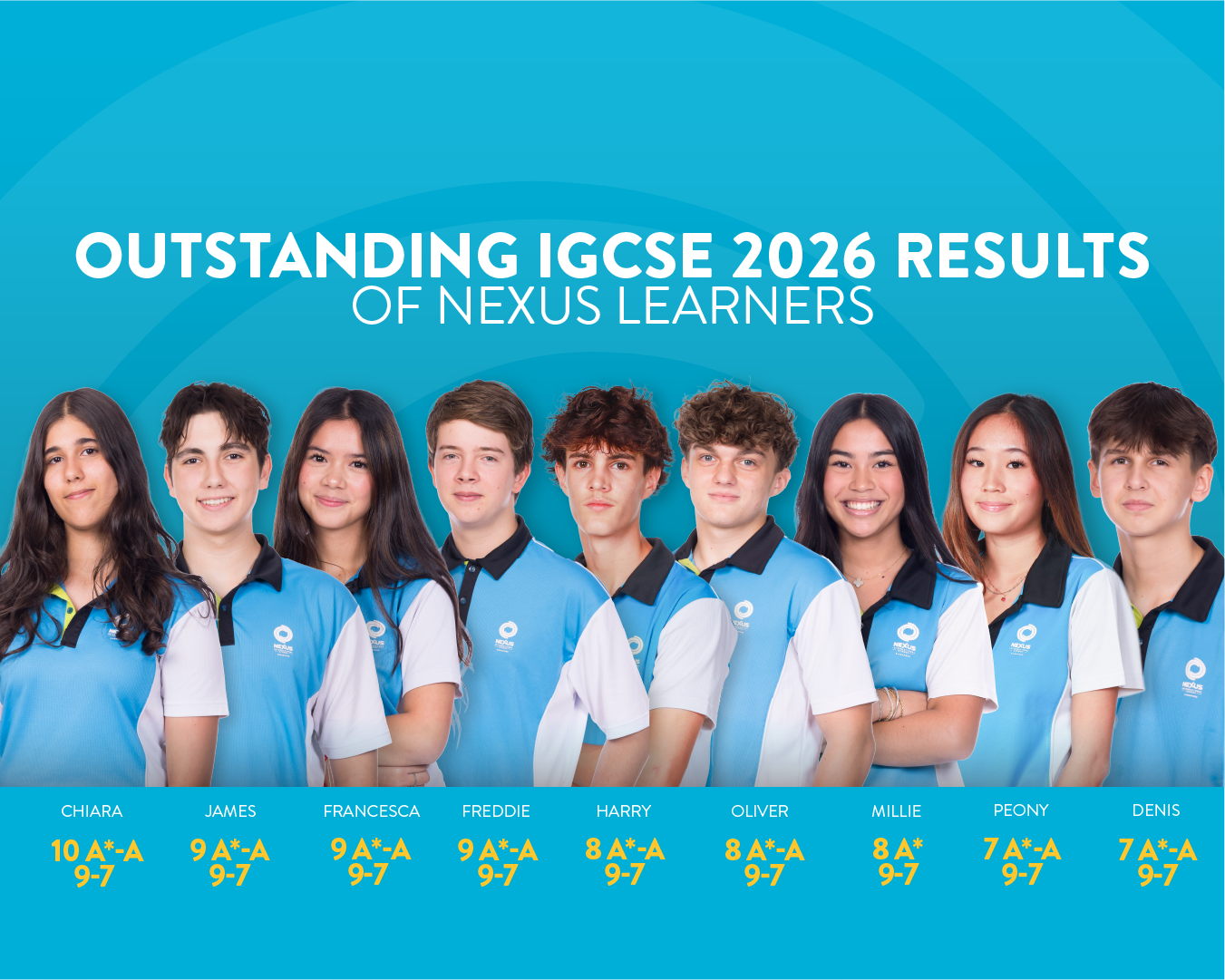
In our 2025 IGCSE Maths results, an impressive 54% of all grades achieved were A–A* or 9–7, with the most common grade being an A or 8/9. Results are equally strong at IB level, exemplified by our 2025 IBDP graduate Minh, who achieved the full 45 points in the IBDP, including HL Mathematics and an Extended Essay focused on a Maths topic.
Current Year 12 learner, Julian also secured the highest mark in Singapore for IGCSE Further Pure Mathematics – an achievement a Nexus learner has earned for the last three years. Often recognised as one of the most challenging IGCSE subjects, this achievement is a testament to both our learners’ dedication and the expertise of our Secondary Maths team.
Building Confidence and a Love of Maths
Beyond results, our Maths department shares a clear and consistent goal: to develop a genuine love of mathematics, both in and out of the classroom. They aim to ensure that every learner believes they can succeed in Maths through hard work, persistence, and the right support.
As James Cairns, Learning Area Leader for Secondary Maths explains, “Maths is part of everyday life — from calculating the cost of lunch to understanding real-world situations and practical applications.” This belief underpins every lesson, helping learners see Maths as relevant, meaningful, and achievable.
Excellent results don’t happen by accident. They are built over time, starting with a deep understanding of each learner’s strengths, needs, and potential. One of the ways we support this is through the careful and purposeful use of assessment data, including the Progress Test in Maths (PTM).
Looking Beyond the Classroom
While teachers see your child’s learning and effort every day in class, the PTM allows us to view progress within a wider context. It is a standardised assessment that compares our learners’ performance with thousands of students across the UK and internationally.
This isn’t about “testing” for the sake of it.
Used alongside the professional judgement of our teachers, the PTM helps ensure learners are appropriately challenged and supported in every Maths lesson. The insights gained allow us to:
Identify high-ability learners early and provide the stretch and challenge needed to keep them engaged.
Spot learning gaps quickly, so support can be put in place before small misunderstandings become barriers.
Plan lessons that meet learners where they are, supporting steady and meaningful progress.
Making Sense of the Data
Information from the PTM supports teachers not only in lesson planning, but also in the targeted and tailored feedback shared with learners and families through reports and learner summaries. Stephen Donohue, Lead for Cognitive Profile Interpretation & Targeted Academic Support in Maths, shares that the real benefit of using data like the PTM is that “as teachers, we can meet the learners where they are and help them reach their potential and beyond.” At Nexus, we focus on a few key indicators to help build a clear picture of learners’ progress:
Standard Age Score (SAS): Rather than a simple percentage, this score takes into account a learner’s exact age in years and months, providing a fair, age-adjusted comparison with peers worldwide.
Strengths and areas for development: Mathematics is broken down into specific skill areas. For example, a learner may demonstrate strong Mathematical Reasoning (the thinking and logic behind Maths) while needing further support with Fluency (speed and confidence of recall).
The whole-child context: Most importantly, we recognise that any test represents just one moment in time. If a learner was tired, unwell, or nervous, teachers consider this alongside everyday classwork, projects, and observations. Data informs our teaching — it never defines the learner.
A Partnership Between Home and School
We encourage parents to view these reports not as a “grade”, but as a conversation starter and a snapshot of what your child may be ready to achieve next. Whether your child is a budding mathematician or someone building confidence with numbers, we use this information to tailor teaching and support individual progress.
Our goal is to nurture learners who feel as confident in the Maths classroom as they do on the pitch or the stage. By combining high-quality assessment data with a strong understanding of each learner, we ensure every child at Nexus has the foundations they need to succeed.
Interested in seeing this approach in action? Book a personalised tour and experience how Mathematics is taught and supported at Nexus.